
How we spend our time is closely related to what we are thinking about. Deliberate thought takes energy and effort, and it is the key to a deliberate life that accomplishes something. Entertainment media, while stimulating thought on some level, tend to direct us away from deliberate thought. But the Bible encourages us to be intentional about our attentions.
The Command
Finally, brethren, whatever is true, whatever is honorable, whatever is right, whatever is pure, whatever is lovely, whatever is of good repute, if there is any excellence and if anything worthy of praise, dwell on these things.
(Philippians 4:8, NAS)
Paul often chains similar things together in “laundry lists” like this. The favorite passage about the “Fruit of the Spirit” in Gal 5:22-23 is a list like this, and so is its complement list of “Deeds of the flesh” in 5:19-21. Here Paul very artfully lists the good, gathering all that is worthwhile into a package; then he issues the command to “dwell on these things.”
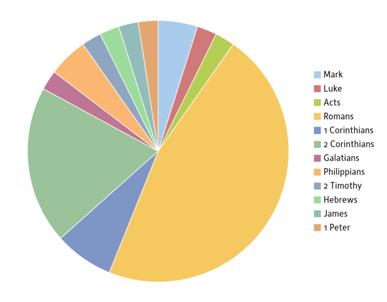 The command is LOGIZOMAI, λογιζομαι, a common word in the NT (41 occurrences) that always addresses a person’s thinking. Paul is particularly fond of this word (33 instances are his), which generally means consider or reckon. He uses it nineteen times in Romans, which is surely a book of Reckoning. Here is an interesting question: Is this word so common for Paul because he was given to reflection and thought, or is reflection and thought central to Paul’s objective subject matter? The liberal theologian will tend to favor the former, while the evangelical will recognize the latter. One results in worship; the other is manifest arrogance.
Logizomai usually deals with forensic justification in Paul’s letters. It is the word that is translated “credited” when Paul quotes Genesis 15:6 and cites Abraham’s faith as the model for justification:
“For what does the Scripture say? “Abraham believed God, and it was credited to him as righteousness.” ” (Romans 4:3, NAS)
It is in Romans 4 where Paul uses logizomai this way the most, 10 times. The idea is to “reckon to someone’s account,” and has a specific accounting nuance in these uses. The modern translations of Philippians 4:8 reflect a different meaning from “reckon in an accounting sense.” Theologically, Paul uses logizomai in this sense to say that God’s righteousness has been credited to us through His work. We call this justification.
The Various Translations
NAS (1977–my favorite English Bible): “Let your mind dwell on these things”
NKJV: “meditate on these things”
Geneva (1599), KJV, Darby, ASV: “think on these things”
NET (New English Translation by DTS), ESV, NIV: “think about these things”
Tyndale (1534): “those same have ye in your mind.”
Before we get the more specific sense of crediting something to someone, we have its root idea, which is simply thinking. So we have a word in Greek that has multiple related meanings, and all the above English translations are basically saying the same thing: It is In Your Head. Logizomai is behind the English word logic, and often the mathematical nuances of logic are meant by the Greek word. Accounting involves calculation and reasoning, but this does not mean Cartesian logic per se. The idea is that in your heart you have a capacity and responsibility to think, to reason, to consider, to ponder. Thinking is a miraculous processes that takes place in that mysterious intersection between your body–the brain–and the immaterial you–the heart. Many believers fail to note this critical forefront of Christian experience, thinking, but here is the command to do so in black and white.
Using The Accounting Metaphor
While Paul does not mean accounting in his use of logizomai here, we can play with it. For you to obey the command to consider carefully, to dwell upon or ponder the good things, you first have to deposit them. If you want to process the information you must first get hold of some. Notice that Paul does not say, “reason your way to the good things that you need to discover within yourself” or some other postmodern, therapeutic drivel for navel-gazers and ne’er-do-wells. His idea in Philippians 4 is based on what has preceded in Philippians 1-3: Jesus as our wonderful Example and the race we are all to run towards His judgment at our resurrection. This is, at least, the objective content Paul would begin with to enjoin our mental exercises.
So if the Truth of the good things to which Paul refers is objective and determined outside of ourselves, then how can we consider, meditate, or let our minds dwell upon these things? Simply put, feed your heart. By the time you’ve read from Philippians 1:1-4:7, you should have some magnificent things to meditate upon!
Objections
1. It is hard to understand the Bible. Solution: Get help: pray about it expecting the Lord to help you; listen to your pastor’s teaching–he’s probably praying for you to get it and studying and teaching exactly what you need to hear, by God’s arrangement.
2. It is too much work. It shouldn’t be this hard. Solution: Confess your sin of arrogance (1 John 1:9) to God the Father and ask Him what He thinks about how much work it should be or how hard it should be. Laziness is the opposite of Christian virtue.
3. The Christian life is not about thinking something but having an emotional experience. Solution: Read the Bible, do a concordance study on the word “heart.” Actually, the Christian life is an integrated whole that addresses the whole person, beginning with what you think. Thinking on the good things should produce an emotional response, but the Christian life is never a lack of emotional control. If you find yourself out of balance, you are out of the Bible.
Three Thoughts
1. A summary description of the Christian life is the dwelling of our minds on the things of God, the truly good things.
2. You have to possess the good things in your heart if you will meditate on them there. This requires acquisition, or the intake of the Word.
3. Many who study the Bible fall short of this command because they think acquisition is the same as reflection. No, actually, you first must get it; then you think on it. Thus the (almost) daily devotions.
Passage to Pray
Psalm 19
Memory Verse:
“Finally, brethren, whatever is true, whatever is honorable, whatever is right, whatever is pure, whatever is lovely, whatever is of good repute, if there is any excellence and if anything worthy of praise, dwell on these things. ” (Philippians 4:8, NAS)
“Grace and peace to you from God our Father and the Lord Jesus Christ”–Paul
 davidroseland.com
Hi David,
Regarding the three objections/conclusions , very cool
As Paul obviously presupposes, all believers- regardless of their spiritual gift- have the exact same ministry of the H.S. available for “studying” the word.
The Pastor’s gift, by Gods design, gives him the advantage in communicating only. This was a very profound insight for me personally ….it will change the way I read/study/meditate on the Bible. Among other things, it puts the responsibility for logizomai where it rightly belongs….the individual believer
J
Right on. God help us if we undo the Reformation by elevating any human above the Word of God.
Speaking of the reformation really enjoying “Triumph of Truth”
Hi Pastor Dave,
Mom and I are reading your Daily Devotions for our Bible class every morning. Thank you. Mom said you should quiz me on Philippians 4:4-8. It is one of my graded memory verses.
Hi TIff, Great to hear these are useful to you. Here’s a quiz for you: How many “commands” do you count in Philippians 4:4-8? Repeated commands count!