
Sometimes our faith seems absurd in the face of the overwhelming tide of its antithesis in the world around us. But the tide is not really overwhelming, and the flood is actually God’s to command. From Genesis 12:1 to Revelation 22:21 the Bible is a story of the minority who have access to the Creator through faith in Him. Do you have it?
The Command
Now the Lord said to Abram, “Go forth from your country, And from your relatives And from your father’s house, To the land which I will show you…. ” (Genesis 12:1, NAS)
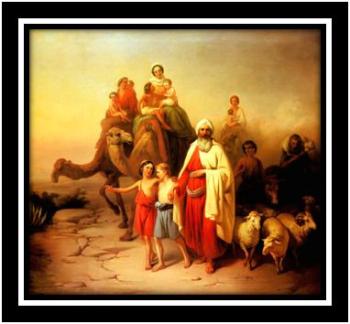 This event is a singular turning point in the Genesis narrative, where God restricts the Plan of human redemption in the Seed of the Woman (Gen 3:15) to one family out of all the families of the earth. God started with one man, Abram, and brought about the miracle of Calvary, the Resurrection, and eventually the Kingdom of David’s Greater Son. The relativists and inclusivists will hate the implication of a restricted revelation from Sovereign God, Whose view of truth is the view.
Nevertheless, this is the wonderful reality in which we live. God called Abram and made him a great nation, a blessing, and the heir to the Land.
Today’s command is one of separation, based on God’s greater plan for Abram’s life. God commanded, and Abram responded in faith. In so doing, we see that greater plan unfold in the rest of the Bible. He had not a clue what God was ultimately doing with and through him, but he responded to the command, to our eternal joy.
A Weighty Requirement
From what was he to separate? Geography is implied in the word “Go forth,” הָלַך, HALAK in the imperative. But the command is more than geography. Astronomers continue to dazzle us with their discoveries from high-tech telescopes; the galaxy is too large for us to fathom, and it is small compare to the rest of the known universe. From the galactic picture, Abram’s geographic move was pretty small. But the move meant everything.
Land
The three separations of God’s command in Genesis 12:1 are “country,” “relatives,” and “father’s house.” These three things that Abram would “lose” or give up, God promised to replace, in vv2-3. And the replacement was infinitely better than what he lost. The “country” is the basic word in Hebrew for “land,” אַרֶז, ARETZ. The parallelism is really tight between this word in the command and the corresponding promise in the second part of v1, “to the land (ARETZ) which I will show you.” The command is “Go from your land…to the land I will show you.” God’s command was not a removal but a replacement.
Relatives
The next separation, “from your relatives” is not just a function of geography. They were not welcome to come with him, as the story bears out, because this is about separation from
everything
to God. Even Lot, called righteous in Hebrews 11, was in the way of Abram’s full obedience, for the promise is not restated until after they separate in Gen 13:14. “Your relatives” is the word מוֹלֶדֶת, MOLEDET, based on the verb meaning to beget. This is a versatile word that can often mean one’s descendants–begotten ones through the generations. But it also means one’s relatives, fellow branches on the “family tree.” This would be the broader of the two statements of family separation.
Father’s House
Often in the Hebrew Bible we find a progression from least to greatest. The last separation commanded by God is the greatest, in my view. Abram was commanded to separate from his “father’s house.” This is the third use of “house,” בַּיִת, BAYIT in the Bible. The first is talking about the structure on the Ark of Genesis 6, but the second is Noah’s “household.” Noah and his three sons and all four wives amounted to Noah’s “household.” Closely related to this word is the transmission of inheritance. The sons of Noah were their father’s heirs, as their children would be. That’s us by the way. Apparently whatever Abram stood to gain from his father’s household was in direct contradiction to what God was going to do with him. Historians speculate and archaeologists argue, but Moses is pretty clear that Abram was to separate from all that his world had taught him to expect. Abram’s name would no longer be Abram, “From a High Father,” but Abraham, “Father of Many Nations.”
How important is obedience? God tells Abram to “Go,” to separate from everything familiar to him, and doing so brings about eternal life for all who believe (Jn 11:25-26). How might the outcome of Abraham’s decision to obey shock him, had he known fully what God was doing for the human race with him? How might the outcome of our decisions shock us?
Three Thoughts
1. God’s commands to separate may be restrictive, but they never restrict His blessings.
2. Abraham is used throughout the New Testament as an example of the Faith. Are you ready to follow that example? What’s holding you back from going wherever God wants you to go? From separating yourself from whatever He wants you to separate?
3. Mystery is a key component of the Biblical presentation. Abram did not know what was at stake in his obedience to God’s command, but he knew the Source of the command. That was enough for him, and by God’s design it should be enough for us.
Passage to Pray
Luke 14:26-33
Memory Verse: Genesis 12:1-3
“Now the Lord said to Abram, “Go forth from your country, And from your relatives And from your father’s house, To the land which I will show you; And I will make you a great nation, And I will bless you, And make your name great; And so you shall be a blessing; And I will bless those who bless you, And the one who curses you I will curse. And in you all the families of the earth will be blessed.” ” (Genesis 12:1–3, NAS)
“The grace of the Lord Jesus be with all the saints.”–John
 davidroseland.com