
We get up. We go to work. We work. We go home. We recover. We do it all over again. Such should be our ambition (1 Thes 4:11)! The work you do is for a wage, a reward commensurate with your production. There is a very agreeable arrangement in which you can trade your time, talent, and hard work for your family’s needs. When you are in debt, you work hard towards the goal of paying off your debt. When we were “dead in [our] transgressions and sins” (Eph 2:1, 5), we owed a debt we could never repay. No amount of hard work on our part would make even the slightest dent, for the debt we owed was the Righteousness of God, and in sin we could only produce what God’s Righteousness condemns (Isa 64:6, Titus 3:5). Imagine the Atlantic Ocean as the debt and your works as a teaspoon trying to bail water.
That is the absurdity of every system of religion, whereby man is supposed to secure the favor of the Living God by earning it. Hold fast to your confession of Christ and only Christ as your claim to Righteousness. The Bible’s commands for your righteous works are not a replacement of the Work of Christ.
The Text
“So then, my beloved, just as you have always obeyed, not as in my presence only, but now much more in my absence, work out your salvation with fear and trembling; for it is God who is at work in you, both to will and to work for His good pleasure. ” (Philippians 2:12–13, NAS)
I find it very interesting that the translators of all the conservative English versions of the NT (and the NIV) suggest a clarifying, interpretive translation for Philippians 2:12. Let me show you what I mean: Keep your eyes on the verb:
Text Comparison – Philippians 2:12
New American Standard Bible: 1995 Update | Php 2:12 So then, my beloved, just as you have always obeyed, not as in my presence only, but now much more in my absence, work out your salvation with fear and trembling;
The New King James Version | Php 2:12 So thenTherefore, my beloved, justas you have always obeyed, not as in my presence only, but now much more in my absence, work out your own salvation with fear and trembling; 6.8% difference
Authorized Version (KJV) | Php 2:12 So thenWherefore, my beloved, justas youye have always obeyed, not as in my presence only, but now much more in my absence, work out your own salvation with fear and trembling;. 12.3% difference
1890 Darby Bible | Php 2:12 So thenthat, my beloved, justeven as youye have always obeyed, not as in my presence only, but now much morerather in my absence, work out your own salvation with fear and trembling;, 14.7% difference
The NET Bible | Php 2:12 So then, my beloveddear friends, just as you have always obeyed, not asonly in my presence only,but now mucheven more in my absence, workcontinue working out your salvation with fearawe and trembling;reverence, 26% difference
English Standard Version | Php 2:12 So thenTherefore, my beloved, justas you have always obeyed, so now, not only as in my presence only,but nowmuch more in my absence, work out your own salvation with fear and trembling;, 18.9% difference
The New International Version | Php 2:12 So thenTherefore, my beloveddear friends, justas you have always obeyed,—not asonly in my presenceonly, but now much more in my absence,—continue to work out your salvation with fear and trembling;, 24.3% difference
Exported from Logos Bible Software 4, 11:19 PM September 26, 2010. This is a text-comparison of all the selected versions with the NASB-95, my go-to English Text for reading by Americans who speak American English.
The verb is KATERGAZOMAI (κατεργάζομαι), which means primarily “to bring about a result by doing something, achieve, accomplish, do (BDAG, p.531).” This word means to work, to produce or cause a desired change through the application of effort. Verse 12 literally says “bring about through your effort your own salvation with fear and trembling.”
Notice in the pie-chart that Paul likes this word, KATERGAZOMAI, 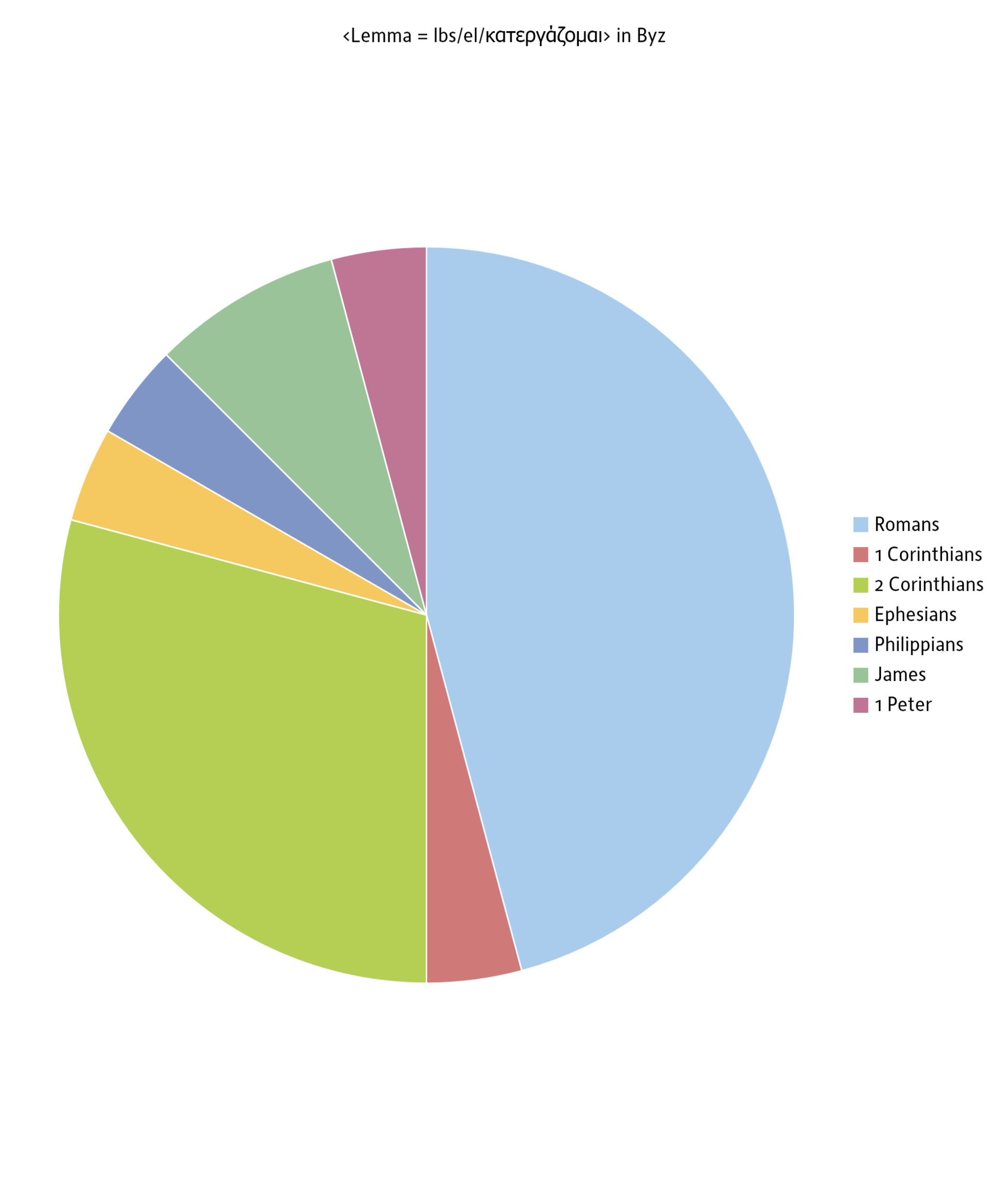 and he uses it eleven times in Romans, the Systematic Theology of grace-through-faith salvation in the New Testament. Nowhere in Romans does it refer to salvation! In Romans 15:18, Paul refers to “what Christ has accomplished through me” as his only boast. Compare that with Philippians 2:13–all the works of his apostleship.
Some writers suggest that we resolve the seeming contradiction between grace and works in Philippians 2:12 by redefining the verb. I do not believe the verb is the key to unlocking the difficult construction. It’s object, salvation, is the key.
INTERLINEAR
μετὰ φόβου καὶ τρόμου τὴν ἑαυτῶν σωτηρίαν κατεργάζεσθε·
with fear and trembling the of yourselves salvation be bringing about
It’s The Word “SALVATION”
I contend that the context (2:5-11) construes the sense in which Paul means “salvation” in v12. Jesus worked for our salvation on the Cross and gave it to us as a free gift (Rom 5:15-16, 6:23). We are working-out our salvation in the pattern of His humility–“with fear and trembling.” I have just used the English word “salvation” in two different senses that are related. We are conditioned to read “salvation” and think “final deliverance from the Lake of Fire” or “forgiveness of our sins through the Blood of Christ.” Doubtless most of the uses of the SOTERIA in the NT are a reference to this ultimate deliverance. However, sometimes, as with Philippians 2:12 the focus is not the Work of Christ in our place as much as the words and works of Christ as our example. If we look at one aspect of salvation–as deliverance from sin–we will readily see how we can be at the same time “saved” once and forever and yet needing to “work out our salvation.” That is, we are free in Christ from the penalty and power of sin over us, but we still battle the presence of the sin nature, according to Romans 6-7.
There was an errant theology centuries ago that claimed Jesus did not die as a substitute for sinners but to show them how to be good people. I reject this heretically weakened, Socinian view of the atonement with all my heart. However, look closely: Philippians 2:5-13 is not a discourse on the atonement. This is a passage that tells us to live and die like Jesus Christ–“have this thinking in you which was also in Christ Jesus.” His path of humble submission to the Father’s will took Him all the way to the Cross, and “for this reason He was also highly exalted….”
“Work out your salvation with fear and trembling” is about your post-conversion experience, which is to be patterned after Jesus Christ. Note the audience (Phil 1:1). Having once taken Christ as our Savior by faith, we are, like Paul, to say, “I have been crucified with Christ; and it is no longer I who live, but Christ lives in me; and the life which I now live in the flesh I live by faith in the Son of God, who loved me and gave Himself up for me. (Gal 2:20)” Being “in-Christ” is called “positional sanctification” because we need a categorical term to express this thing Paul keeps saying about us: we are “in Christ.” Likewise Christ is living in us; He is working through us. His attitude is to be our attitude (Phil 2:5). His exaltation (2:9) He will share with us, His Bride the Church.
So act like it, “for God is the One working in you both to will and to work for His good pleasure.” That which is true by our position is to be lived out in our experience through the power of Jesus Christ within us. This is nowhere stated in the Text to be inevitable for the believer, and thus our observation that so many seem truly to have believed but have little development of that Christ-like character. The commands we have in the Text make us responsible to hear and obey, as it has always been. God working in us makes us capable of responding in works that please Him.
Three Thoughts:
1. Soteriology: Salvation “by grace through faith” is not by works; it is for works.
2. Christology (Doctrine of Christ): Within the eternal counsels of God, the Second Person, the Eternally Pre-Existing Son, though co-equal with the Father in essence, has always submitted to the will of His Father. When He entered the human race, the Son of God lived-out this submission to the Father’s authority all the way to the death of the Cross. He is both our Substitute and our Exemplar.
3. Sanctification (The Christian Walk): The highest character quality you can possess is the kind of selfless humility that Jesus demonstrated as He obeyed the Father and relied on the Spirit. Humility and submission to the Father’s plan is the only real path to the believer’s maximum glory for all eternity, as with our Savior.
Passage to Pray: Romans 8:31-39
Memory Verse: Phil 2:12-13
“So then, my beloved, just as you have always obeyed, not as in my presence only, but now much more in my absence, work out your salvation with fear and trembling; for it is God who is at work in you, both to will and to work for His good pleasure. ” (Philippians 2:5–13, NAS)
 davidroseland.com